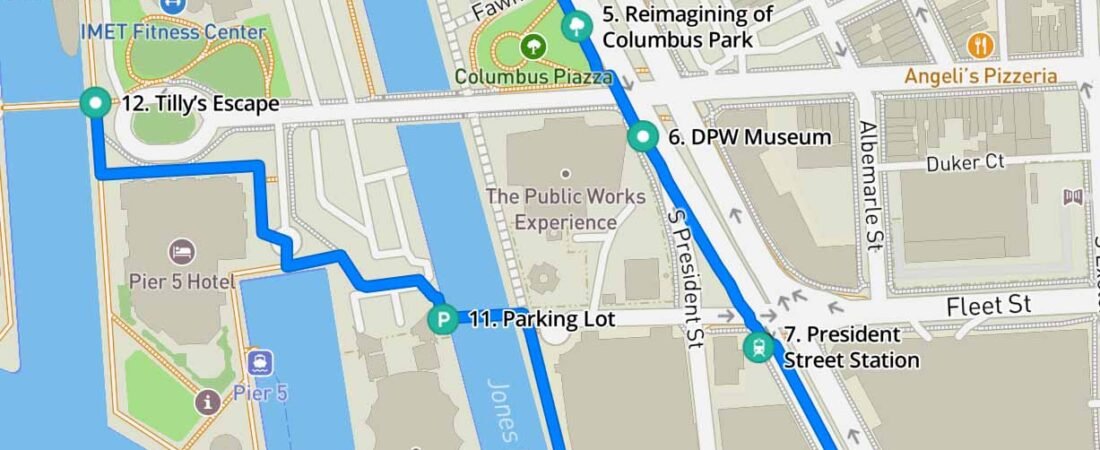
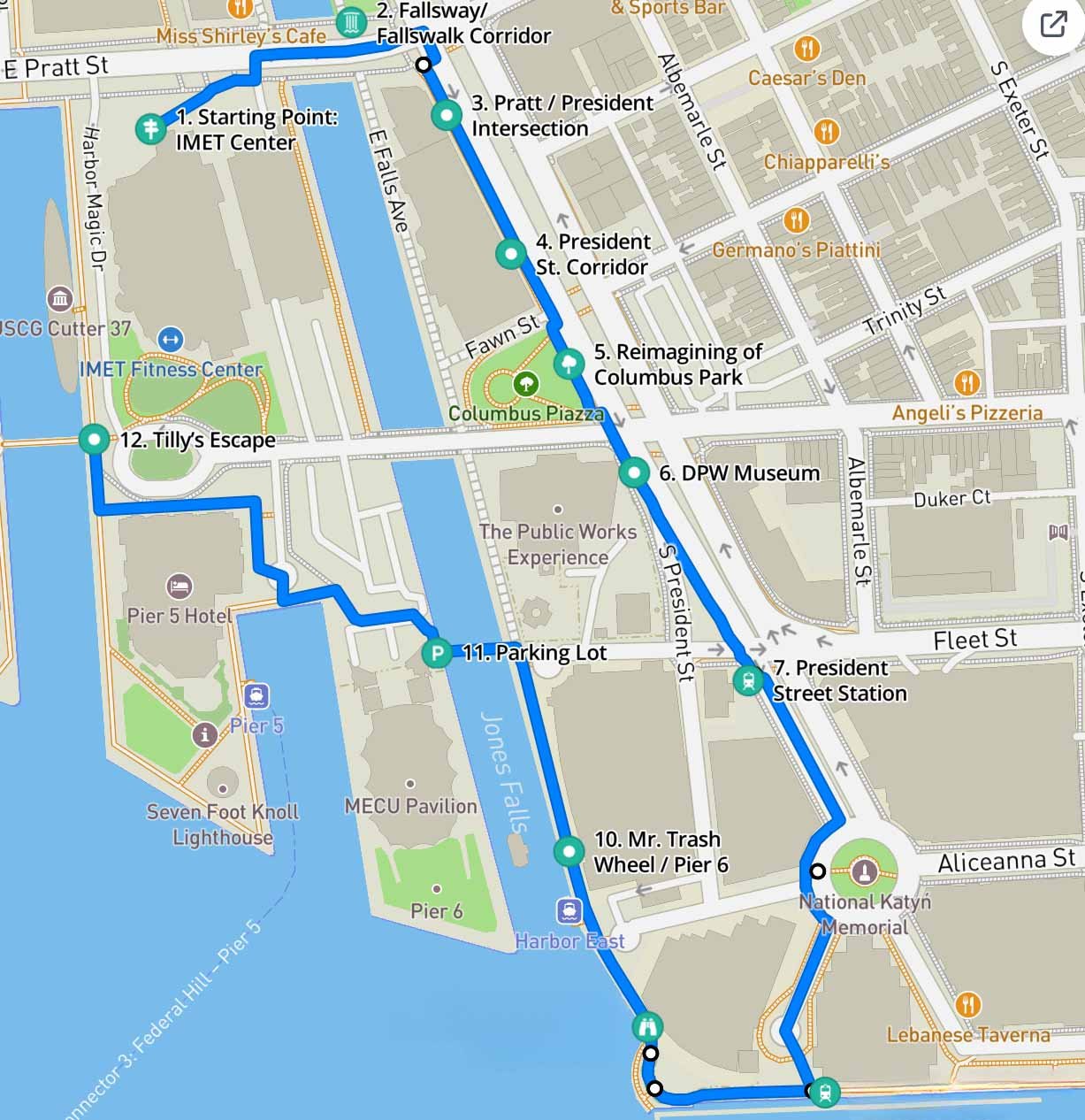
- Starting Point: IMET at Rita Rossi Colwell Center
- The Institute of Marine and Environmental Technology (IMET) is a multi-university hub for research and innovation along Baltimore’s waterfront, highlighting the connection between the city, the harbor, and environmental sustainability. (location)
- Q: What ideas for collaborations and community learning arise for you in this place?
- Fallsway/Fallswalk Corridor
- Here a buried river emerges into a concrete-lined path as it flows into the Inner Harbor. (location)
- Q. Here, at the intersection of the city’s infrastructure and a living (and also damaged) river, what unrealized potential do you imagine for people to connect with a restored and
- Pratt & President Streets intersection
- This major crossroads forms a barrier dividing the surroundings into four separated quadrants. The important Reginald Lewis Museum, for example, is effectively cut off from harbor pedestrians due to the constant and conflicting throughmovement of cars. (location)
- Q. What ideas for people-centered redesigns could support a unified and accessible sense of place?
- President St. corridor
- Here, the environment shifts quickly, showing how mixed-use development shapes access, supports or blocks community flow, and impacts the lived experience of the city in daily life. (location)
- Q. What hidden assets do you notice? How could these be activated and interconnected into a coherent and vibrant place?
- Columbus Park
- This park represents an opportunity to rethink how public space can serve residents, visitors, and neighbors as a welcoming green space that supports connection and gathering. (location)
- Q. How could this previous “monumental” space be reimagined for community healing and restoration? How can the broader park area be enhanced and activated for wide public use?
- The Public Works Experience
- The recently rebranded Baltimore Public Works Museum building features an architectural flourish as evidence of pride in the public works infrastructure that keeps our city functioning, and creates space to reflect on the intrinsic relationship between civic systems, labor, and community health. (location)
- Q. How could this site, under its new name, be activated to educate all ages more widely about the complex systems required for city life, and honor the essential role of city government in providing clean and healthy water to its citizens?
- President Street Station
- Formerly named Baltimore Civil War Museum, this train station is a historic and cultural landmark that reflects Baltimore’s transportation legacy and ongoing evolution as a city shaped by movement, trade, tragedy, and connectivity. (location)
- Q How can this historic museum, largely isolated and hidden as a traffic island, be lifted up and interconnected to tell its powerful stories?
- Harbor East
- The Marriott and Four Seasons hotels, anchoring this corner of Harbor East, stands as visible examples, among other high-end high-rise waterfront developments, raising questions about equity and inclusion in these private and public borderland spaces along our waterfront. (location)
- Q. What ideas do you have for activating an inclusive sense of belonging and equitable use in public waterfront places like this that culturally present as private or exclusive?
- Baltimore Promenade path and view
- This site on the promenade path provides a wide view of the waterfront and surrounding neighborhoods—creating an opportunity to reflect on how higher education (and other anchor institutions and coalitions) could lead with values and prioritize community engagement. (location) Q. What values, commitments, and practices along the waterfront can support positive community development, mutual partnerships, and long-term investment in neighborhoods off the harbor?
- Q. What ideas do you have for activating an inclusive sense of belonging and equitable use in public waterfront places like this that culturally present as private or exclusive?
- Mr. Trash Wheel
- Mr. Trash Wheel (and Trash Wheel family) is a hallmark of social entrepreneurship, and a powerful force for environmental learning and responsibility in an ecosystem that requires sustained care and protection. (location)
- Q. How could this Jones Falls entry point be elevated as a model teachable space for urban environmental restoration and sustainability in a city built upon multiple watersheds?
- Pier Six Pavilion and parking lot
- This iconic amphitheatre provides a premier space for live outdoor entertainment on the water, however it hosts only a handful of events annually and dominates the area with sprawling surface parking. This city asset most often serves as a border vacuum blocking access and pedestrian movement right in our central public space. (location)
- Q. How could you reimagine land use and creative programming in this area that flows from a community and people-centered vision?
- Ending Point: Tilly’s Escape
- The Tilly’s Escape marker honors Underground Railroad Conductor Harriet Tubman and the escape story of an enslaved woman named Tilly. Nearby an unmarked site holds the story of young Fred Bailey’s arrival from the Eastern Shore in 1826 (hint: You may know him better as Frederick Douglass!). (location)
- Q. How can these and Baltimore’s myriad stories of courageous and creative resistance, liberation, and leadership be elevated and centered in Baltimore’s core identity and woven into our renaissance story?

Related Articles
-
Hello, World!
Hello, Baltimore! Welcome to Reimagining the Harbor as a Hub. We are here to engage with multiple Harborplace stakeholders as well as a broad public audience, and to make…
Leave a Reply
You must be logged in to post a comment.